

Skip to main content Microsoft Defender Microsoft Entra Microsoft Intune Microsoft Purview Microsoft Security Copilot Microsoft Sentinel View all products AI-powered cybersecurity Cloud security Data security & governance Identity & network access Privacy & risk management Security for AI Small and medium business Unified SecOps Zero Trust Pricing Services Partners Why Microsoft Security Cybersecurity awareness Customer stories Security 101 Product trials How we protect Microsoft Industry recognition Microsoft Security Insider Microsoft Digital Defense Report Security Response Center Microsoft Security Blog Microsoft Security Events Microsoft Tech Community Documentation Technical Content Library Training & certifications Compliance Program for Microsoft Cloud Microsoft Trust Center Security Engineering Portal Service Trust Portal Microsoft Secure Future Initiative Business Solutions Hub Contact Sales Start free trial Microsoft Security Azure Dynamics 365 Microsoft 365 Microsoft Teams Windows 365 Microsoft AI Azure Space Mixed reality Microsoft HoloLens Microsoft Viva Quantum computing Sustainability Education Automotive Financial services Government Healthcare Manufacturing Retail Find a partner Become a partner Partner Network Microsoft Marketplace Software companies Blog Microsoft Advertising Developer Center Documentation Events Licensing Microsoft Learn Microsoft Research View Sitemap

This post is authored by Andrew Marshall, Principal Security Program Manager, TwC Security, Yanbing Shi, Software Engineer, Internet Information Services Team, and Sourabh Shirhatti, Program Manager, Internet Information Services Team.

As a follow-up to our announcement regarding TLS 1.2 support at Microsoft, we are announcing new functionality in Windows Server 2012R2 and Windows Server 2016 to increase your awareness of clients connecting to your services with weak security protocols or cipher suites.

IIS logs can already be used to correlate client IP address, user agent string, and service URI. With the addition of the new custom logging fields detailed below, you will be able to quantify the usage of outdated security protocols and ciphers by clients connecting to your services.

To enable this new functionality, these four server variables need to be configured as the sources of the custom fields in IIS applicationHost.config. The custom logging can be configured on either server level or site level. Here is a sample site-level configuration:


Each SSL info field is a hexadecimal number that maps to either a secure protocol version or cipher suite algorithm.
For an HTTP plain-text request, all four fields will be logged as ‘-‘.

A sample log and explanation of the new fields follows:
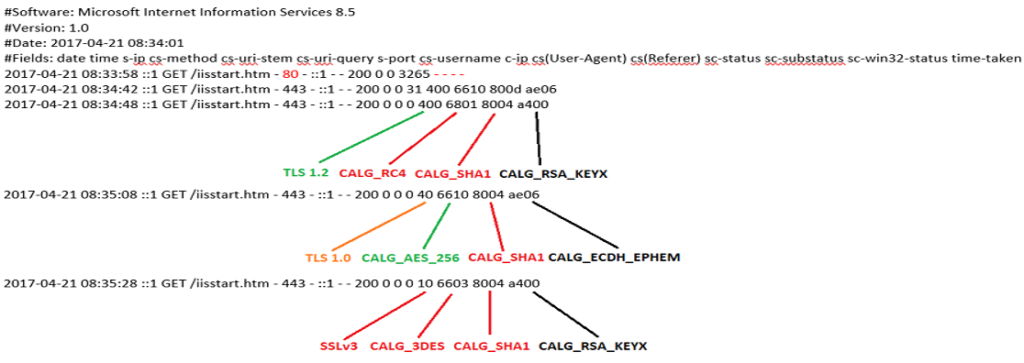
A screenshot showing different SSL fields

For more information visit Official Microsoft Documentation for Custom Logging Fields in IIS.

  • Two men looking at multiple monitors
    24 min read

    The Gentlemen ransomware: Dissecting a self-propagating Go encryptor

    Microsoft Threat Intelligence presents a comprehensive analysis of The Gentlemen, a Go-based ransomware deployed by affiliates of Storm-2697 that combines per-file ephemeral key encryption with an aggressive self-propagation module to deploy itself across an entire network using series of simultaneous lateral movement techniques per target.
  • Woman with headset on a customer service support call
    11 min read

    Undermining the trust boundary: Investigating a stealthy intrusion through third-party compromise

    Microsoft Incident Response investigated an attack operated through legitimate and trusted administrative mechanisms to blend seamlessly into routine operations and remain undetected demonstrating that intrusions have increasingly avoided using noisy exploits, obvious malware, or custom tooling, instead leveraging systems that organizations already trust within their environments.
  • Photo of developers discussing with the hexagon and the supply chain attack icon in overlay
    16 min read

    Mitigating the Axios npm supply chain compromise

    On March 31, 2026, the popular HTTP client Axios experienced a supply chain attack, causing two newly published npm packages for version updates to download from command and control (C2) that Microsoft Threat Intelligence has attributed to the North Korean state actor Sapphire Sleet.