
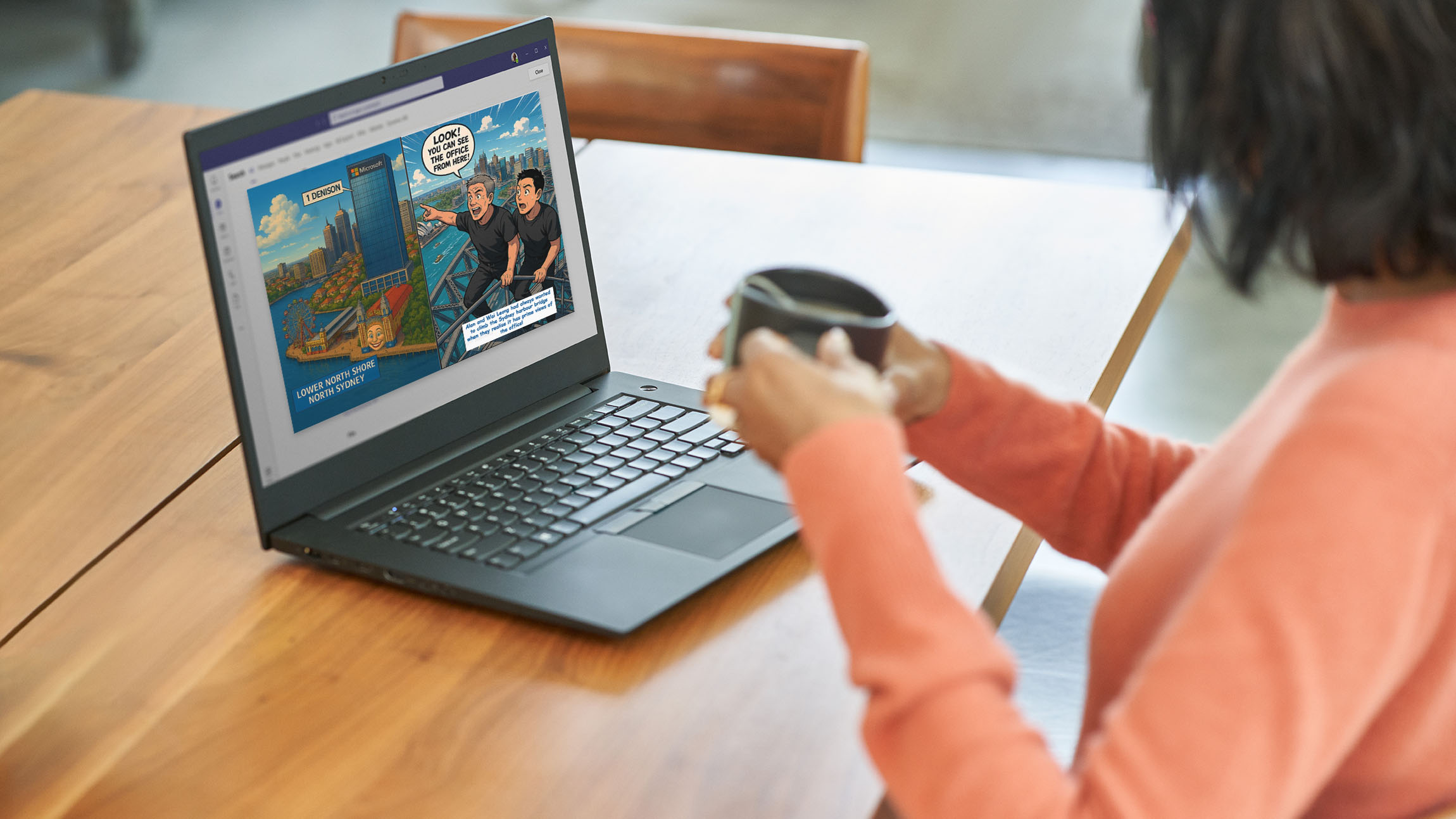
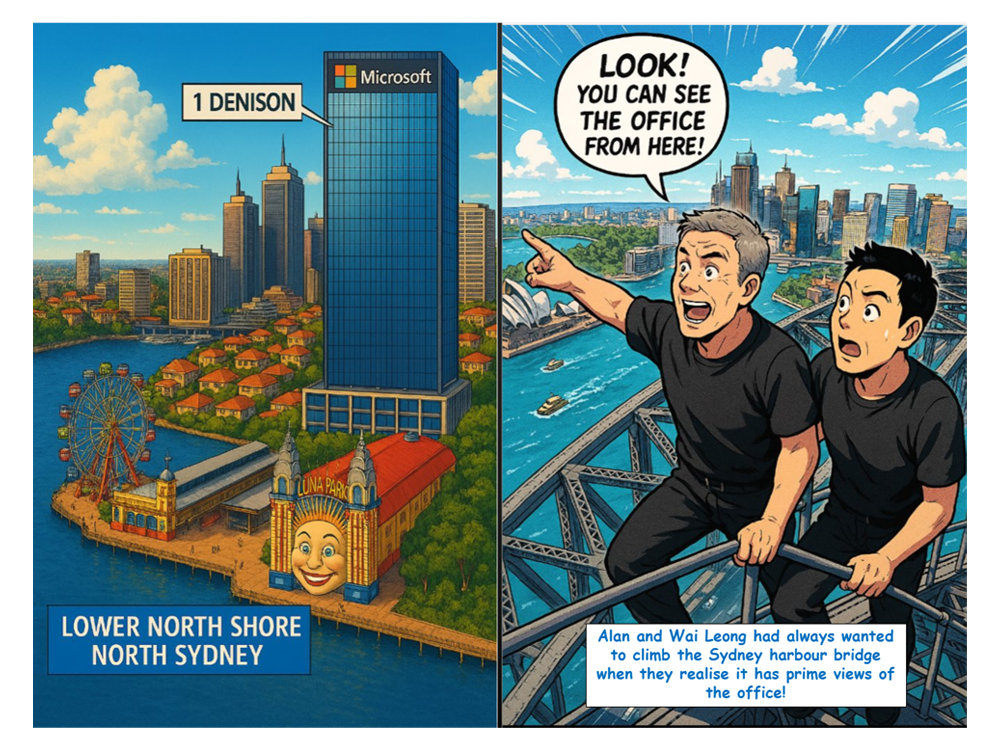
Here at Microsoft Digital, the company’s IT organization, we believe AI can be a powerful force for building community. In our Microsoft Asia region, our employees recently used AI tools to create a collaborative digital comic book featuring regional leaders traveling across Asia in a hot air balloon, visiting teams in different countries and learning about their local cultures along the way.

“To bring us together, we definitely got creative after COVID, and even more so when AI came in. We did a lot of fun team games where we would share and represent our region.”
Petra Glattbach, senior business program manager, Microsoft Digital
What began as a creative experiment to reconnect people in the post-pandemic era quickly became a way for globally distributed employees to reconnect with one another after years apart.
The comic book—the brainchild of Petra Glattbach, a senior business program manager based in Australia—grew out of a broader effort to rebuild personal connections across a region spanning Australia, New Zealand, Japan, China, Singapore, and India.
“To bring us together, we definitely got creative after COVID, and even more so when AI came in,” Glattbach says. “We did a lot of fun team games where we would share and represent our region.”
For many years before the COVID-19 pandemic, these teams had maintained a strong sense of community through regular regional gatherings and global conferences, creating a rhythm of in-person collaboration and camaraderie that they deeply valued.
Pre-pandemic, companies around the world hosted in-person events to keep their networks strong and make new connections. Remote work was an outlier, and most businesses operated on a face-to-face basis. COVID and its accompanying restrictions transformed professional interactions around the world, platforming remote work as the norm.
Microsoft was no exception.
Maintaining connection in a distributed world
Microsoft 365 Copilot was being rolled out during this time, and employees were encouraged to incorporate it into their daily workflows. Like many people across different businesses and industries, having our employees incorporate AI into daily work was equal parts exciting and anxiety-inducing for the Asia teams.
The employees in the Asia region thus found themselves trying to solve two challenging problems: How do you foster real workplace community when in-person meetups are infrequent and difficult? And how do you build your confidence with AI tools in the workplace? Maybe, they thought, there was a way to tackle both challenges at the same time.
The Asia teams initially focused on the community-building side of the quandary. They started small, organizing gatherings like themed quiz games, cultural trivia, and other online events designed to bridge the gap between the virtual and real worlds.
In the spirit of our company’s AI rollout, the Asia region also began experimenting with different forms of AI. They initially used it for more organizational tasks, such as event brainstorming and planning. However, once they began experimenting, it occurred to them that more creative, community-driven projects might be the perfect opportunity to encourage people to learn about AI while having fun and building closer relationships between geographically separated teams.

“What it really did for us was normalize the idea of using AI. It allowed us to move culturally from trying to use this new technology to do our jobs to the idea that it can help us in many different ways.”
Alan Stone, senior director of business programs, Microsoft Digital
The advent of Hello There
The teams started with some small-scale creative team games and experiences, such as making songs and short videos that represented their different cultures. For instance, every six months one of our teams would run an event they called “Hello There.” They’d randomly assign three people from different parts of the world to find a half-hour in their week for a conversation, and suggest a topic for the group to chat about.
At a time when the company was no longer regularly flying employees together in person, the initiative helped recreate the spontaneous personal connections that had once happened naturally during regional events and conferences. They then asked the participants to use AI to generate an image that told the story of the things they spoke about, which they posted in a dedicated Viva Engage channel.
The generated images were fun for everyone to see and comment on, and they helped employees learn more about one another. The experience gave globally distributed employees an opportunity to connect not just as coworkers, but as people, despite the distance between them.
“What it really did for us was normalize the idea of using AI,” says Alan Stone, senior director of business programs in Microsoft Digital. “It allowed us to move culturally from trying to use this new technology to do our jobs to the idea that it can help us in many different ways.”
Using AI for a creative group project
After a few regional cycles of iterative experimentation with these creative capabilities, our teams in Asia decided to use AI for a more ambitious group project—something that would require teams from multiple countries to work together toward the same goal. They wanted to create an item that represented the Asia region, celebrated their unique cultural attributes, and boosted the AI literacy of their employees.
That’s where Glattbach’s comic book idea came in. Inspired by the popularity of manga and graphic storytelling across Asia, she had the idea of showcasing both the technological capabilities and powerful collaborative nature of AI by creating a comic book using AI-driven tools.
She proposed the project in a meeting with Stephen Kerametlian, a senior director of business program management in Microsoft Digital. Knowing his love of James Bond films, his team created a comic book of Kerametlian as a Bond character, flying to visit employees in countries around the region. Kerametlian says receiving a personalized, AI-generated comic book from team members he hadn’t physically seen in years was a defining and personally touching moment.
“They even managed to get my wife and two-year-old son into the book,” Kerametlian says. “We’re an international team. Through that comic book, I was able to travel the world and ‘see’ my entire team, which I haven’t seen in person since before the pandemic. We had so much fun with it.”
Glattbach’s idea was then translated into a wider-reaching effort across the different teams based in Asia. Groups in different countries would each create a chapter of the shared narrative. Two regional leaders, Alan Stone, and Wai Leong Chan, were main characters in the story, traveling across Asia in a hot air balloon and touching down in each country to visit the team and learn about their culture.
The project enabled team members to learn to use AI while completing a fun and creative effort together. Regional leaders created a purposefully safe, low-stakes environment to encourage experimentation and play.
“It was an opportunity for people have a little bit of fun, knowing they’re experimenting and learning in a safe environment,” says Jane Davis, a director of business programs in Microsoft Digital who’s based in Australia. “I love how easy it was for everybody to get involved and experiment with AI as a shared community.”
The teams prioritized joy and creativity over the final output, encouraging people to work together and fostering an environment where they could learn from one another. Each team shared prompts, compared results, and built on others’ ideas to come up with their country’s chapter of the comic book.

“We unlocked a ton of usage and value from Copilot through something as simple as a comic book. It turned out to be very powerful, and inspired people to use the technology for their own work as well.”
Stephan Kerametlian, senior director of business program management, Microsoft Digital
This larger comic book project was a runaway success. It became a companywide example of successful peer-to-peer learning, cross-cultural exchange, and creative collaboration.
“We were able to rally communities around it; we didn’t have to beg people to join the work sessions, because they were super-popular,” Kerametlian says. “We unlocked a ton of usage and value from Copilot through something as simple as a comic book. It turned out to be very powerful, and inspired people to use the technology for their own work as well.”
Participation grew rapidly; employees were genuinely excited to get involved.
“AI is strengthening our day-to-day productivity,” says Shunsuke Kubota, a senior field IT manager in Microsoft Digital, who is based in Japan. “We’re generating more connections, resulting in more sharing of ideas. I think it’s kicked off an incredible creativity and innovation loop.”
And that’s a win for everyone at Microsoft.

“People think that AI is replacing human connections. We purposely chose to think about creative ways that our community can use AI as an enabler of human connection across geographies in Asia, especially since Microsoft Digital is a global team.”
Jane Davis, director of business programs, Microsoft Digital
Future collaborations with AI
The success of this AI collaboration project has inspired teams across Microsoft to adopt a similar approach to community building, including groups in Europe and the Middle East.
“People think that AI is replacing human connections. We purposely chose to think about creative ways that our community can use AI as an enabler of human connection across geographies in Asia, especially since Microsoft Digital is a global team,” Davis says. “We’re asking, how do you come together as a community? How do you do it in a virtual way, in a way that enables social and experimental learning?”
As these efforts illustrate, when used intentionally and purposefully, AI technology is a powerful tool for amplifying and enhancing human ties in a widely distributed world. As the technology continues to advance, we believe it offers an opportunity to rethink how people connect, learn, and grow together.
“AI is something that’s driving community,” Davis says. “People are discovering these new, innovative opportunities to connect, and AI is their creative partner in making it happen.”
Key takeaways
For organizations that are curious about adopting AI technology to help create their own sense of connection and community, the Asia region’s experience offers a number of lessons:
- Start with people, not technology. Successful community-building initiatives address the human need for connection. Anchor your efforts in relationships and cultural exchange, rather than rolling out AI for its own sake.
- Make experimentation feel safe and low stakes. Encourage psychological safety for your team by making your initial AI experiments easily accessible. Emphasize fun and play over any ultimate output.
- Use AI as a shared learning opportunity. Instead of formal training, let learning happen organically through collaboration. Encourage peer-to-peer learning rather than top-down instruction.
- Combine structure and guardrails with creativity. Providing high-level guardrail materials like shared prompts, formats, and collaboration tools can make project outputs consistent across teams, while leaving plenty of room for experimentation and expression.
Try it out
Related links
- Learn how we used gamification to drive Copilot adoption and make AI learning fun, collaborative, and engaging across teams.
- Read about our efforts to enable meaningful AI adoption internally with a Copilot Expo.
- Explore how we deployed Copilot at global scale and enabled employees to adopt AI through structured guidance and shared learning.
- Discover how we’re using AI and continuous improvement to transform operations while keeping people at the center of change.
- See how we’re using Viva Engage to help employees scale Copilot adoption through peer learning, storytelling, and shared experiences.
- Find out how we’re preparing our employees for the future of work at Microsoft with Agent Launchpad.
