

Cybersecurity risk management at Microsoft is an enterprise-wide discipline spanning governance, engineering, operations, and organizational culture. Through our international operations and diverse portfolio of products, services, and regulatory obligations, we’ve developed a mature, scalable framework designed to facilitate proactive risk identification, structured mitigation, and continuous oversight.
This article presents our approach to cybersecurity risk management, detailing the internal governance structures, lifecycle methodologies, regulatory compliance processes, and organizational practices that collectively promote transparency and accountability. This approach is built on two foundational components: a structured risk management lifecycle and a governance model that integrates cybersecurity risk into enterprise-level decision making.
Governance as the foundation
Microsoft’s cybersecurity risk management program is fundamentally structured around robust governance mechanisms. Central to this framework is the Cybersecurity Governance Council, a cross-functional body composed of the Chief Information Security Officer (CISO), Deputy CISOs (DCISOs), and representatives from legal and regulatory affairs. This council convenes twice weekly to evaluate emerging risks, validate mitigation plans, and ensure alignment with enterprise priorities.
The governance model is designed to facilitate bidirectional communication of risk intelligence. Information flows upward from engineering and operational domains to executive leadership, and downward from strategic oversight to operational execution. This exchange is essential for maintaining situational awareness and ensuring that risk mitigation efforts are both evidence-based and scalable.
At the operational level, DCISOs are accountable for reviewing, prioritizing, mitigating, and accepting risks within their domains. This domain-aligned ownership model ensures that accountability for cybersecurity risk is clearly defined and directly connected to enterprise decision making.
Once risks are identified, they are reviewed on a recurring basis and aggregated to inform enterprise-level prioritization. Risk acceptance decisions are tiered based on residual risk levels and aligned with Microsoft’s defined risk appetite. They are then governed and monitored to ensure consistency and appropriate oversight.
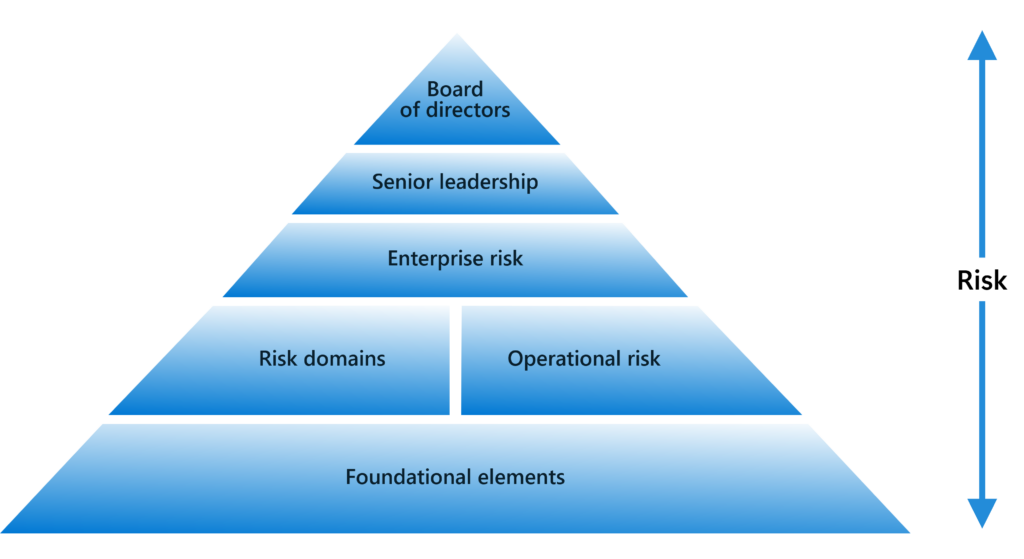
Foundational elements
Listening systems
- Internal and external audits
- Current and pending regulation
- Incidents and media
- Industry groups
Methodology
- Risk management framework
- Risk rating criteria
- Risk universe
Tools
- Power BI
- Risk portfolio and accountability matrix
- Risk assessments
- NIST cybersecurity assessments
Risk domains
- Cybersecurity
- Quality and availability
- Business resilience
- Corruption
- Digital safety and service misuse
- Product safety
- Sustainability
- Global trade
- Antitrust and regulation
- Talent management
- Data privacy
- Supply chain
- Financial
- Facility security and people safety
Operational risk
- Search, advertising, and news
- Artificial intelligence
- Cloud and AI
- Commercial business
- Consumer business
- Security
- Experience + Devices
- Customer and partner solutions
- Gaming
- Corporate, External, & Legal Affairs (CELA)
- Finance
- Human resources
- Business development and corporate strategy
- Marketing
Enterprise risk
- Identify, assess, and prioritize risk to strategy
- Senior leadership accountability and mitigation quality
- Enable board risk governance
Microsoft’s security standards are published on an annual basis, establishing explicit requirements for risk entry, scoring, and mitigation. Adherence to these standards is mandatory for all teams, ensuring uniformity and accountability across the organization. The standards are subject to periodic revision in response to evolving threats, regulatory developments, and historical incident analysis.
The CISO GRC team synthesizes risk intelligence into a semi-annual enterprise risk management (ERM) report. The report is disseminated to senior leadership and the audit committee, elevating cybersecurity risk management from operational domains to the highest levels of organizational oversight.
Microsoft also defines and tracks key risk management metrics to measure and evaluate the effectiveness of its cybersecurity risk management program, providing visibility into risk posture over time and enabling informed decision making as part of governance and reporting processes.
A lifecycle approach to risk management
Microsoft’s risk management lifecycle is organized into four principal stages: identification, assessment, mitigation and remediation, and prevention and monitoring. Each stage is designed to ensure that risks are logged, actively managed, tracked, and validated.
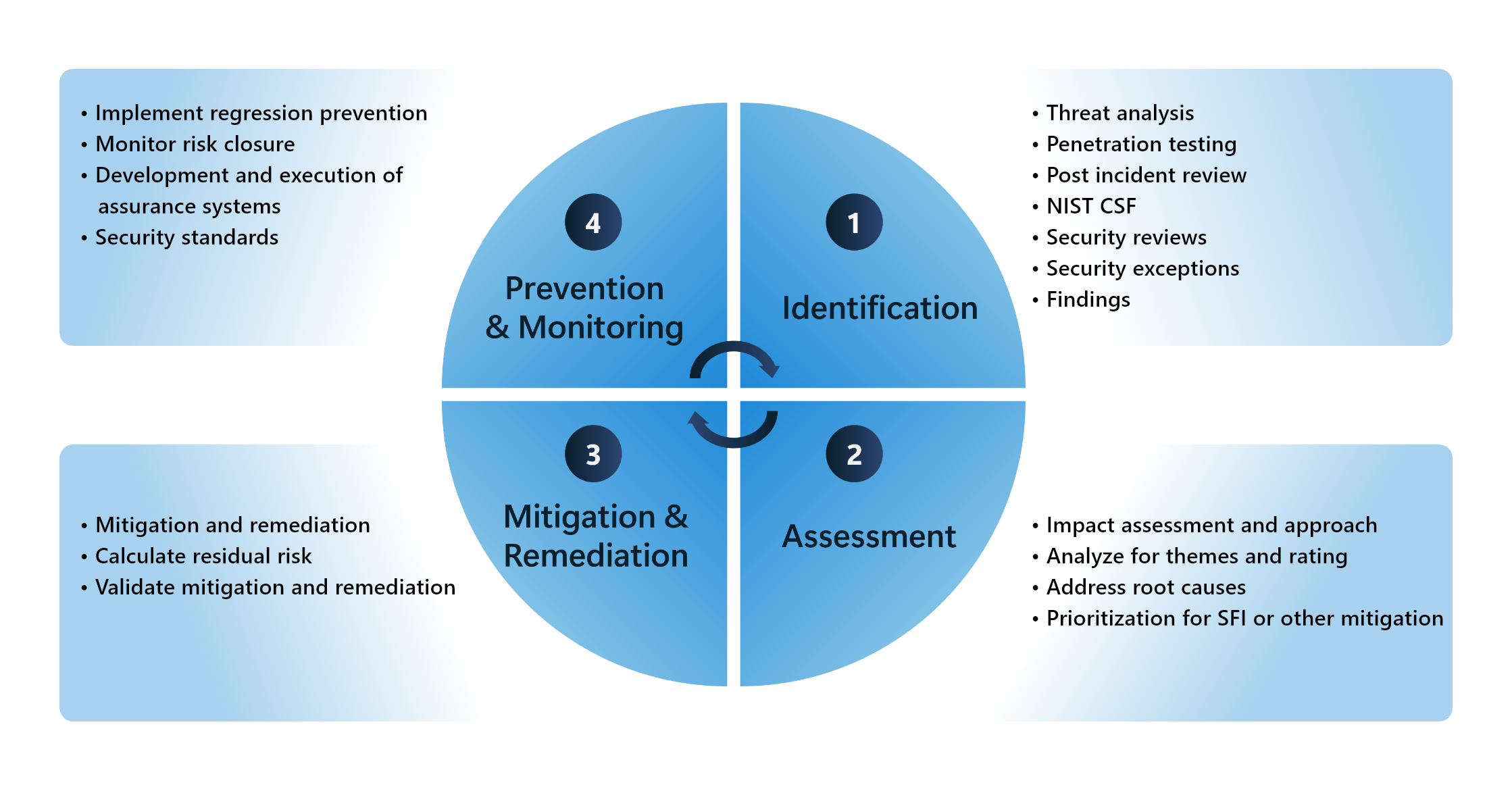
Risk identification draws on a range of inputs, including threat intelligence, penetration testing, post-incident reviews, security research reports, red team exercises, and internal assessments. Risks are also surfaced through self-identification by teams, findings from defense operations, and structured self-assessments, such as the annual NIST Cybersecurity Framework (CSF) maturity review. The process is designed to be inclusive, allowing any employee or vendor with appropriate access to submit risks into a centralized system. This multifaceted approach aims to provide a comprehensive view of the threat landscape.
Upon identification, risks are entered into a centralized risk register, which provides early visibility and facilitates prompt action. The system is designed to be inclusive, permitting any employee or vendor with corporate access to submit risks. This democratized process reflects Microsoft’s commitment to broad-based risk identification across the organization.
Risk assessment is conducted by specialized teams employing structured methodologies, including impact and likelihood scoring, root cause analysis, and contextual evaluation informed by both internal signals and external intelligence. Assessment methodologies align with enterprise risk management practices and incorporate factors such as impact, likelihood, and management action and control opportunities to determine overall risk prioritization. Curators, who are Microsoft domain experts with risk management training, triage and assign risks to the appropriate DCISO area, thereby ensuring consistency and objectivity across all domains.
Risk mitigation and remediation strategies are tailored to the specific characteristics of each risk. Mitigation efforts may be prioritized and driven at an enterprise level through initiatives such as the Secure Future Initiative (SFI), or managed within specific organizational domains depending on scope and impact. These may involve deploying new controls, process adjustments, or implementation of technological solutions. Each risk is assigned an owner who is accountable for executing the mitigation plan and validating its effectiveness. Progress is monitored through workflow systems, and validation steps are employed to confirm the sustained efficacy of mitigations. Following mitigation, outcomes may inform updates to Microsoft security standards to strengthen systemic controls and prevent recurrence.
Prevention and monitoring constitute ongoing activities. Insights derived from mitigation efforts are also used to inform improvements delivered to customers, including secure-by-default configurations, product controls, and published guidance. Microsoft utilizes regression prevention techniques, continuous monitoring tools, and assurance systems to ensure the durability of mitigations over time. Insights derived from these activities are reintegrated into the identification process, thereby establishing a continuous improvement loop that is essential for maintaining resilience in a dynamic threat environment.
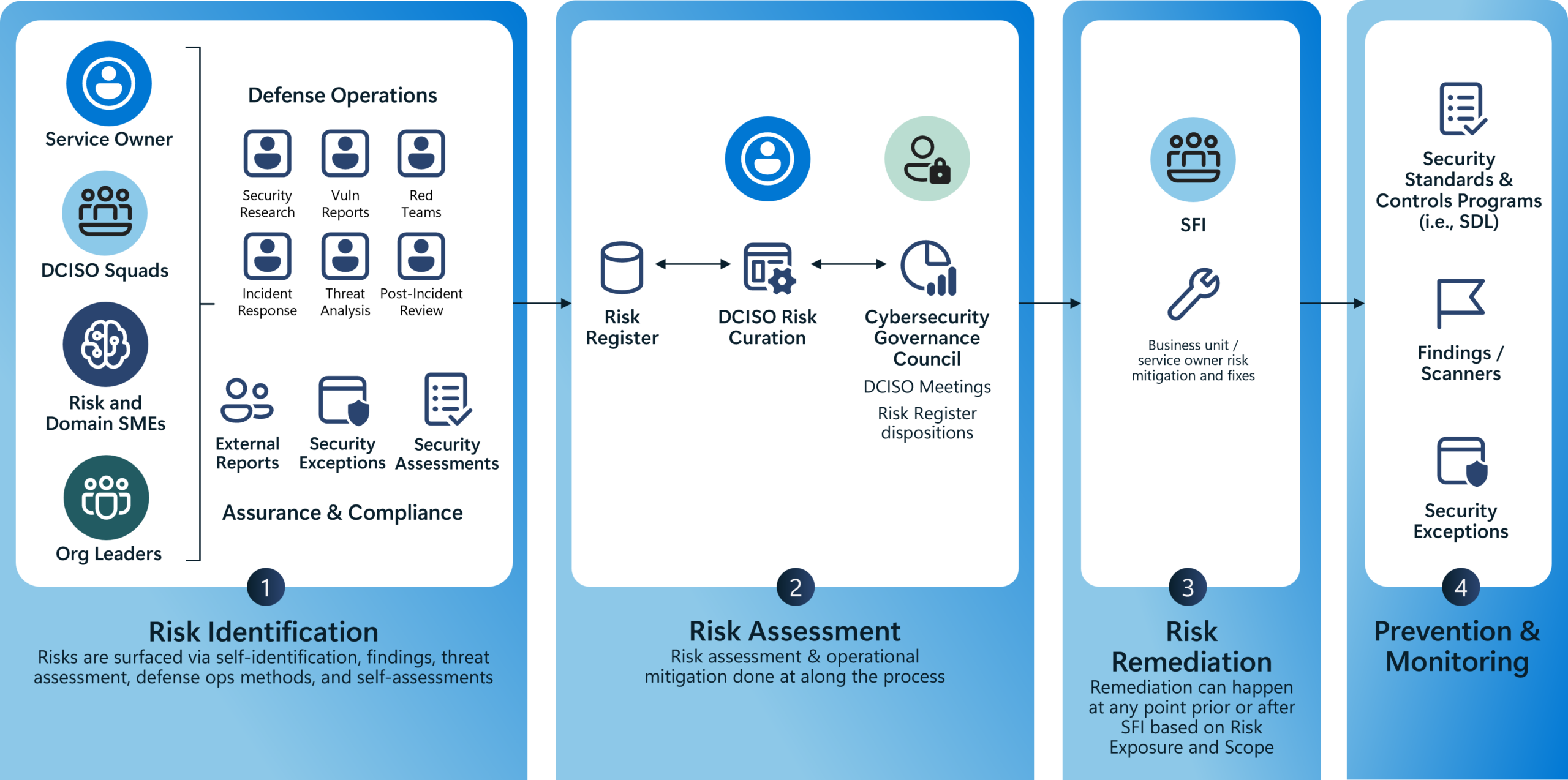
The risk register: Centralized oversight
The cybersecurity risk register functions as the central repository for Microsoft’s risk management program.
The workflow for risk management within the register encompasses seven defined stages: submission, triage, response, confirmation, information sharing, mitigation, and archiving. Each stage is governed by explicit service-level agreements to ensure accountability.
Risks are required to be triaged and scored within a specific timeframe following submission, and mitigation plans must be developed within a defined period after prioritization. Risk owners are required to provide regular, ongoing updates on the process of mitigation activities.
To support this workflow, roles within the risk register are clearly delineated:
- Risk Submitter: Responsible for providing comprehensive descriptions and supporting documentation for identified risks
- Risk Curator: Charged with validating, prioritizing, and assigning risks to appropriate domains
- Risk Owner: Accountable for implementing and monitoring mitigation plans
- Risk Viewer: Individuals such as auditors and senior leaders who access risk data for oversight and compliance purposes
In addition to these roles, DCISOs provide domain-level oversight and accountability for risks, including prioritization, acceptance, and escalation to enterprise governance structures.

Risk Submitter
The Risk Submitter is an individual, FTE or vendor who enters a new or existing risk into the Risk Register. Anyone with corp access can submit a risk, including Microsoft security experts. Responsible for submitting a clear, detailed, and understandable title, description, and supporting information for a risk.

Risk Curator
Delegated to take action by their DCISO, these are engineers, architects or analysts with respective domain knowledge and context who are responsible for triaging and prioritizing submitted security risks, ensuring the right DCISO area ownership alignment, identifying ownership, and tracking remediation.

Risk owner
The Risk Owner is an FTE, typically in a DCISO’s scope, that is responsible for updating mitigation status of a prioritized risk. This accountability continues until all mitigations are complete and the risk is deprioritized or archived.

Risk Viewer
The Risk Viewer is an FTE who requires read-only access to risk data to fulfill a business or compliance obligation. Where possible, their access is limited to PBI reports instead of direct access to the Risk Register itself.
Risks are reviewed on a quarterly basis, and prioritized lists are communicated to leadership to inform strategic decision making. The centralized risk register enables prioritized risks to be surfaced and reported to the CISO function and Enterprise Risk Management (ERM), supporting enterprise-level visibility and oversight. These prioritized risks inform the Secure Future Initiative (SFI), which drives systemic change across Microsoft.
Regulatory compliance integration
Microsoft’s cybersecurity risk management program is aligned with global regulatory frameworks, including ISO 27001, NIST SP 800-53, and the NIST Cybersecurity Framework, and is continuously updated to incorporate emerging requirements such as DORA and NIS2. These regulatory baselines inform both control implementation and risk evaluation, ensuring alignment between compliance requirements and operational risk management activities.
DCISOs are responsible for regulatory implementation and compliance within their respective domains. This encompasses oversight of regulated sectors such as healthcare, legal, and government, as well as emerging domains including artificial intelligence safety and privacy. The Cybersecurity Governance Council conducts regular reviews of regulatory risks and ensures that mitigation strategies are aligned with statutory and legal obligations.
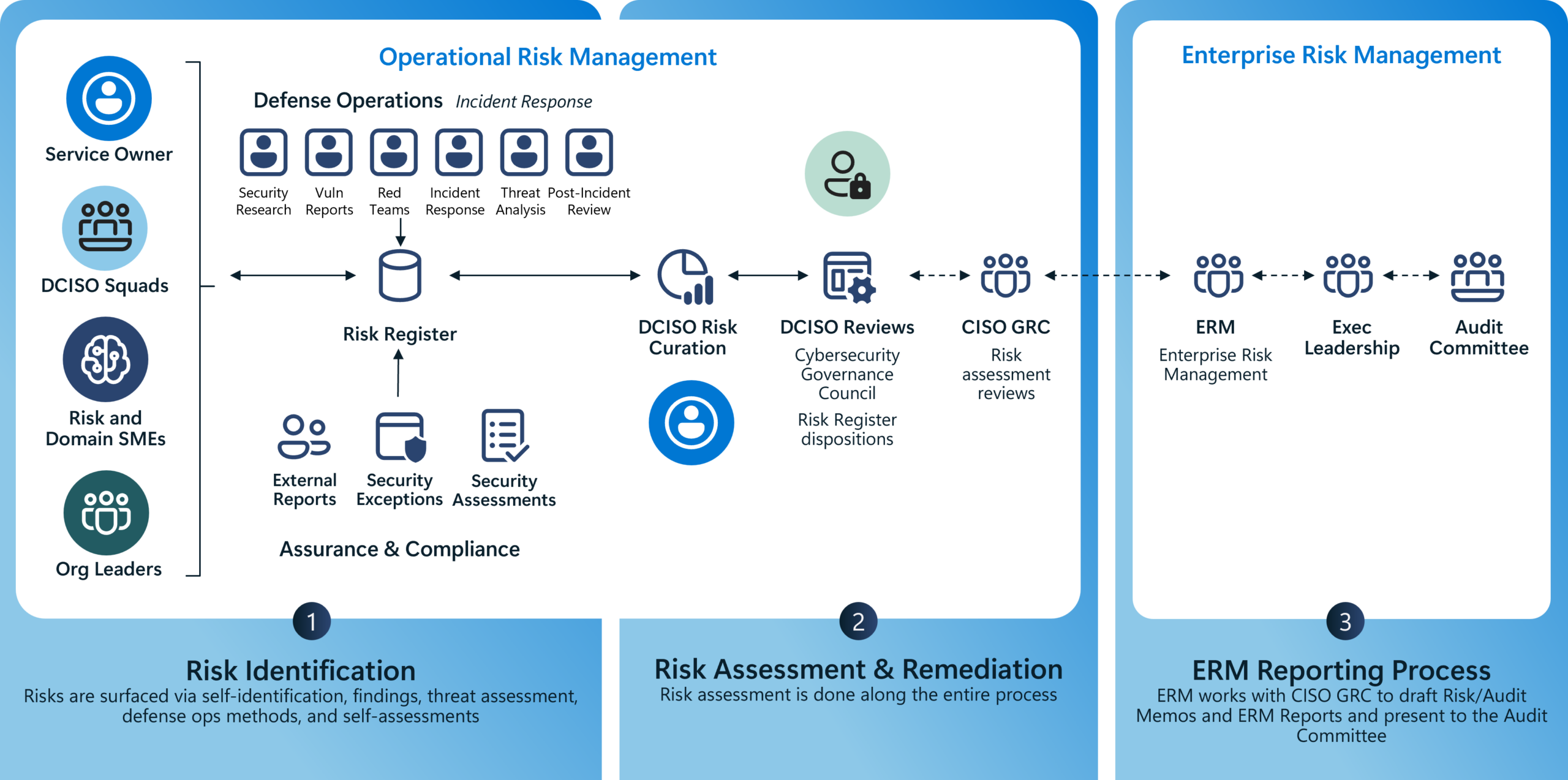
ERM reporting integrates cybersecurity risks alongside financial and operational risks, thereby ensuring that regulatory compliance is embedded across the organization’s overall broader risk posture. This integrated approach enables Microsoft to respond expeditiously to regulatory changes and maintain trust with customers, partners, and regulatory authorities.
What makes Microsoft’s approach unique
The scale and complexity of Microsoft necessitate a risk management methodology that is both rigorous and adaptable. Several practices distinguish Microsoft’s program from industry counterparts.
The Secure Future Initiative (SFI) establishes a structured mechanism for driving systemic change, prioritizing critical risks and aligning mitigation efforts across engineering, operations, and executive leadership. While not all risks are represented within SFI, the initiative functions as a strategic accelerator, publicly articulating the prioritized risks and corresponding mitigation efforts that drive enterprise-wide improvements.
The culture of risk awareness is embedded throughout the organization. Risk identification is actively encouraged, and submissions are evaluated irrespective of origin, reflecting a commitment to democratized and proactive risk reporting. Internally, Microsoft advocates for a culture that celebrates the identification of risks and enables proactive reporting.
The governance cadence is highly disciplined; the Cybersecurity Governance Council convenes twice weekly, and DCISOs conduct reviews and confirm top risks every 90 days. These structured intervals ensure that risk management remains proactive, with clear accountability and continuous oversight.
The integration of operational and enterprise risk is seamless. The CISO GRC team synthesizes risk intelligence from across the organization and presents it in a unified ERM report, ensuring that cybersecurity risks are incorporated into strategic decision making, rather than isolated within technical silos.
Finally, Microsoft’s control ecosystem reinforces the durability of risk mitigation. Initiatives like the Secure Development Lifecycle (SDL), exception governance processes, and SFI collectively ensure that mitigations are implemented and sustained over time.
A blueprint for security leadership
Microsoft’s cybersecurity risk management program is a model of maturity, scalability, and transparency. The program integrates structured governance, rigorous processes controls, and a culture of accountability to ensure that risks are systematically identified, mitigated, and subject to continuous monitoring and improvement. For cybersecurity leaders seeking to understand risk management at scale, Microsoft offers a compelling blueprint: a proactive, integrated, and transparent framework that combines structured governance, rigorous process controls, and a culture of accountability.
Ultimately, cybersecurity risk management is not solely dependent on technical controls and frameworks; it is fundamentally about empowering individuals, building trust across teams, and connecting operational rigor with strategic clarity. If you are developing or refining your program, prioritize both structural and cultural elements, and build resilient processes around engaged teams. Security leadership presents significant challenges, but with the appropriate structure, culture, and rhythm, it can drive transformative outcomes.
Key takeaways
This article is not solely an account of Microsoft’s practices; it is a call to action for security leaders. If you are responsible for cybersecurity in your organization, here are five practical takeaways you can implement—regardless of your company’s size or industry:
- Establish a structured governance cadence. Implement a regular schedule for risk management activities. While Microsoft’s Cybersecurity Governance Council convenes twice weekly, the essential principle is consistency. Monthly risk reviews and quarterly board updates can ensure sustained visibility and actionable oversight of cybersecurity risks.
- Enable accessible risk reporting. Facilitate open channels for risk submission, allowing all stakeholders to contribute to risk identification. Democratizing risk reporting fosters transparency and organizational trust.
- Integrate operational risk with strategic oversight. Elevate operational risks to enterprise-level reporting to ensure their inclusion in strategic decision making. Collaboration between security and enterprise risk teams is critical for comprehensive oversight. Risks that stay buried in technical teams rarely get the attention they deserve.
- Implement structured risk lifecycle processes. Define clear roles, responsibilities, and timelines for each stage of the risk management lifecycle. Even in smaller organizations, a simplified version of this model can enhance accountability and progress tracking.
- Proactively align with regulatory expectations. Maintain alignment with relevant standards and regulations, such as NIST, ISO, DORA, and NIS2. Regularly review emerging regulation requirements and collaborate with legal and compliance teams to ensure readiness.
Try it out
Related links
- Learn how we’re implementing a Zero Trust security model at Microsoft.
- Watch Stephanie’s video about cybersecurity risk management at Microsoft.
- Read about how we’re deploying Microsoft Baseline Security Mode internally.
- Watch a video about applying engineering fundamentals to help secure AI featuring Microsoft Deputy CISO Yonatan Zunger.
- See how we’re using AI to reinvent our network security.
